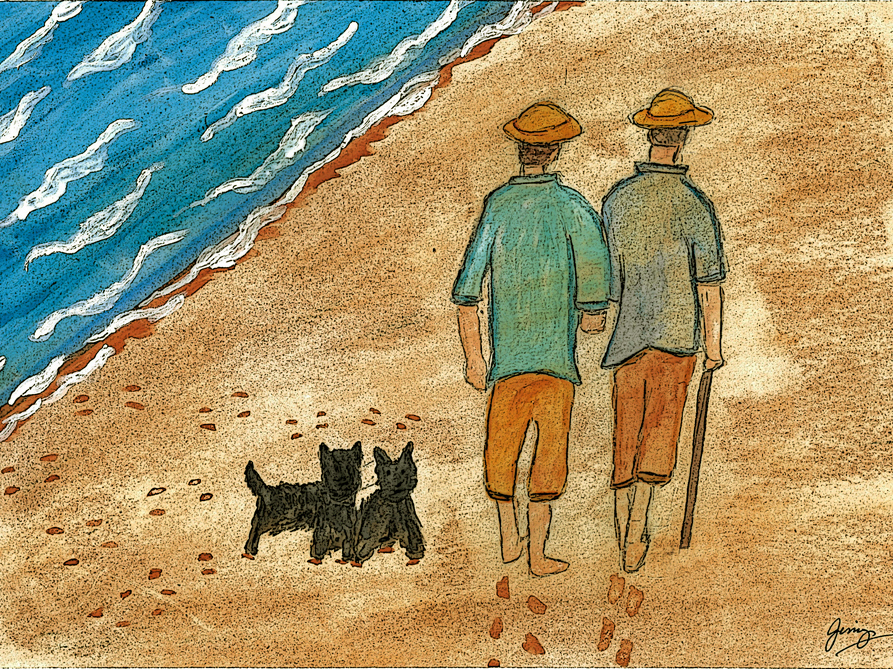
Sands Point
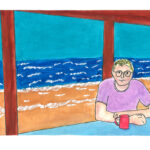
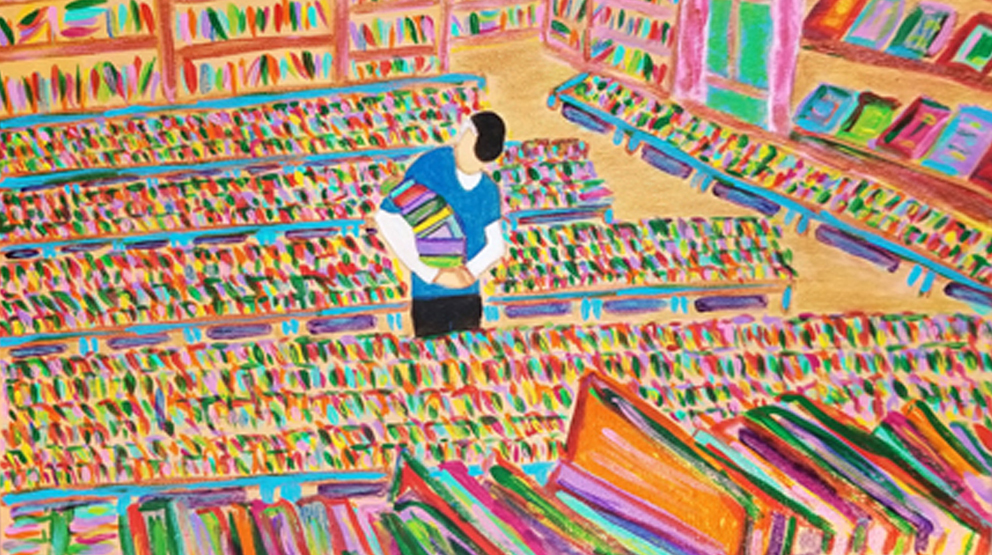
illustration by Jameson Currier
SANDS POINT
by Jameson Currier
Sean and Noah arrived at the front steps wet; their feet and hands and hair covered with sand. Before Kate could remind them to rinse off at the shower stall at the side of the house, they were already on the veranda telling their grandmother, Meg, about the dogs they saw on the beach. The boys, seven and five, said the two dogs kept barking and chasing each other, “just like they were friends,” Noah squealed.
“What kind of dogs were they, honey?” Bree, the boys’ mother asked, arriving at the front door with towels.
“Short yappy dogs,” Sean said, breathing in large gulps of air through his mouth.
“The kind with whiskers,” Noah added.
“Were they small black dogs?” Meg asked, looking over at Kate.
Noah nodded and said, “They kept barking and barking.”
“They were chasing us toward the house,” Sean said, “And then they were just gone. We couldn’t find them anywhere. They disappeared!”
“Go rinse that sand off,” Bree said, aborting her efforts of brushing off her children with the towels, and barking out a set of commands. “No cookies — you’ll spoil your lunch. And don’t be too noisy. Uncle Cory is upstairs reading.”
* * *
In mid-July Meg had called Kate to say that she was worried that their younger brother Cory might be selling his house. “He’s in the dumps over Douglas,” Meg said.
For a second or so, Kate had an image of her brother and his lover Douglas at the beach — both dressed in similar looking shorts and T-shirts, the ocean foaming around their long legs as they each dipped one of Meg’s grandchildren in and out of the surf. Cory, now sixty-five and retired from teaching, had lived at Sands Point for more than forty years. Cory and Douglas had been together for more than thirty years. Meg and Kate had both charted out regular visits during the summer months, overlapping stays with Cory and Douglas’s guests, or Meg’s daughter, Bree, her husband Bryan and their two children.
Kate had planned to skip her visit to the shore this summer, but her sister’s phone call had changed her mind. When she arrived at Sands Point in August, she was surprised to see that her brother already had a new, younger boyfriend. Douglas had only died the spring before, after a series of complications following abdominal surgery. In the last year Cory had been a patient care partner, changing IV needles and emptying plastic cups used as urinals. The new boyfriend’s name was Justin and he was younger than Meg’s daughter, Bree. Justin was rail thin and wore a leather choker at his neck. He had thick brown hair that grew straight up like grass and a self-focused immaturity, interrupting a conversation to say he couldn’t find his swimsuit or needed a new pair of sunglasses or he wanted to go into town to see a movie. Kate found his constant neediness irritating, completely unlike the once-healthy bearish and bearded Douglas, who had always doted on Cory’s family and guests. At first, Kate thought Justin was Cory’s hired help — a young college boy at the shore for the summer who Cory had employed to help him with the upkeep of the house — just as Cory had once done when he was that young — or perhaps he was a relative of Douglas’s come to relieve Cory during his grieving period. She was surprised, too, when after dinner her first evening Cory and Justin kissed each other in full view of everyone — Meg, Bree, the young boys — and then retired together to Cory’s second-floor bedroom.
“That boy’s going to give Cory a heart attack,” Kate said, seriously but with a light-hearted laugh to mask her worry. “He’s too old to be acting like a teenager.” Kate was now sixty-seven. She had never been comfortable with imagining the physical mechanics of what happened between gay men in the bedroom, though she had loved and adored Douglas as strongly as her brother had. Douglas, barrel-chested and good-humored, had always been the one to set everyone at ease and put things in motion, the one lighting up the barbecue grill, pumping the bicycle tires, setting up a badminton net in the back yard. At dinner her first evening in the beach house, Kate had noticed that Justin had not helped with the cooking or the cleaning, which even Bree’s young boys had the good manners to do, or setting up the silverware or taking the dirty plates to the kitchen sink. Still, it was clear to Kate that Justin had found a niche in the household beyond Cory’s bedroom; Bree’s young sons seemed to like him as though he was a playmate and not as one of the other adults — he tossed Frisbees with them on the beach, gave them advice on their computer games, and showed them what extra condiments he liked to add to his hamburgers and hot dogs. She felt Justin was like a big bright fleshy toy which had been delivered to the beach house by mistake but no one was ready yet to return.
Kate couldn’t help but be suspicious that Cory was reacting too emotionally and too quickly after Douglas’s death and that Justin’s motives might be more than romantic. She doubted that Cory even thought about selling Sands Point now with Justin in the house. Meg had not even brought up the subject again with Kate since her arrival. Kate knew that her feelings might be because she was at a vulnerable point herself. Russ, Kate’s second husband, had died at about the same time Douglas had. Russ and Kate had been in a grocery store, arguing, when Russ had a heart attack. At the time, Kate thought he had slipped on something spilled on the floor. In hindsight, she had blocked out a lot of the memories of the trauma. She couldn’t even remember what they had been arguing about.
* * *
“I heard those dogs have been here every summer,” Justin said to the boys at lunchtime. “Ever since your granny and Uncle Cory were kids.”
“He’s not my uncle,” Sean said. “He’s my great uncle.”
Sean and Noah had washed off their sand and changed into clean T-shirts and shorts. Like Justin, they were eating grilled cheese sandwiches and potato chips which Meg had made; Cory, Meg, and Kate were having soup with their salad, even though it was forecast to be a hot day, temperatures rising into the nineties. “Wow, that means they’re really old,” Noah said, through mouthfuls of food.
“Stop feeding them nonsense,” Meg said to Justin, with a rolling, light-hearted laugh. Meg was now sixty-nine. Like Kate, she was picking the raw onions out of her salad that Cory had added. “No way those are the same dogs.”
“They are, they are,” Cory said, nodding his head. Cory always seemed to be brighter, livelier with the rest of his family, when Bree’s young boys were around, as if he saw something in them that the women did not know how to recognize. Now he seemed to be playing a secretive game with them — as much to keep Justin impressed as he was to keep the boys entertained. “Justin’s right. They show up every year ‘bout now.”
“You mean, they’re like a hundred years old?” Sean asked.
“Not that old!” Kate said, her laughter rising and falling with the same cadence as her sister’s.
“They’re the same age when your granny and Nana Kate first saw them,” Cory said. “They don’t ever age. Every year they come back to the same place.”
“Unh uh,” Sean protested. His younger brother, Noah, had stopped eating, his mouth open with astonishment.
“Ghosts,” Cory said, now nodding his head for emphasis. “They’re ghost dogs.”
“No way,” Sean answered. “Dogs can’t have ghosts.”
“Who said they can’t?” Justin added, a potato chip paused before his lips. “Who says they don’t love it here as much as we do? How cool is that?”
* * *
Meg, Kate, and Cory had been coming to the shore since they were children — their father rented a small two-bedroom cottage on Simple Lane for the summer months. “The Best Place To Be Cottage,” as that small house was nicknamed with a hand-painted wooden sign beside the front door, had big, high rooms with cracks in the walls from too much heat and moisture. Their mother had kept the rooms dark and cool, fans blowing long before there were any air-conditioners. Their father only came on the weekends, riding the bus up from the city, and on the mornings that their mother spent baking cakes or pies or muffins, they had the run of the beach with the other summer kids.
You couldn’t see the public beach from The Best Place To Be Cottage, but it was only across the street and a tumble down a small dune. Most of the time Cory stayed in the kitchen with their mother — the girls were also young — Meg, six, Kate, four, Cory, a handful at almost-two. Some mornings Meg would lead Cory by hand down to the beach when their mother joined them, unfolding a blanket and a large striped umbrella and carrying a basketful of apples or a cake to enjoy later with the other women and children.
In those days there were always lots of people at the beach. The folks who lived on the beachfront properties waved to the children from their decks or porches or driveways. There was Mrs. Moeller, mother of Bill and Sam, two teenage boys who spent time on the beach after their part-time jobs behind the counter at the snack shop in the village, and Mrs. Ellis who lived in “Starburst Place” the bright yellow house with her husband and overweight eleven-year-old daughter Nora. Aunt Deena, who wasn’t anyone’s aunt at all but a middle-aged spinster who always asked the older kids to help her with errands, was always around to offer the younger children lemonade or, on special occasions, a chilled soda pop. Two tall men, school teachers from a high school further down the cape, Mr. Nichols and Mr. Baldwin, lived then in Sands Point, the large white clapboard house at the end of the lane. In the mornings they would sit beneath a white canopy on the beach smoking cigarettes and drinking coffee, their two terriers, Nick and Nack, dozing at their feet or sniffing out passersby. In the heat of the afternoons the men would retire to their veranda to lunch and read, while the terriers played on the beach with the children. Late afternoons, or sometimes almost at dusk, the four of them would stroll up and down the beach, the men’s pants legs rolled up to their shins and their balding heads covered by their wide-brimmed hats, the terriers trotting protectively beside them. Visitors always remarked about how similar the two men looked, as if they were brothers. No one questioned two bachelors living together; they’d been army buddies since serving in the same regiment. The only way to tell them apart was Mr. Baldwin’s limp and cane, a result of a wound in his thigh from an important battle (or so it was rumored) and which kept away suspicious comments when his buddy held him by the elbow while walking, helping him maintain his balance in the ever-shifting sand.
On weekends other men came and went from Sands Point, other buddies and veterans. Sometimes Mr. Nichols and Mr. Baldwin would entertain the young, married couples renting the summer cottages — the older men shaking and stirring fancy cocktails for their guests, dinner cooked and served by Thea, a stout woman regularly hired from the village for the occasion.
Kate could remember their mother and father arriving home from those dinners at Sands Point smelling of cigarettes and alcohol and with gossip whispered about the other beachfront residents. And there was always a piece of cake or a slice of pie sent over to the girls by Thea, which Kate or Meg would have to thank the two men the following day for when they were spotted on the beach.
It was also impossible to tell the two black dogs apart. They were always a pair, always circling their owners or barking at a child to toss them a beach toy to chase. Like the kids, they had the run of the beachfront properties — showing up regularly at Aunt Deena’s for an afternoon treat or digging up Mrs. Ellis’ garden.
These idyllic summers ended when the economy changed and their father moved from one job to another and then another. There was not enough money to come back to The Best Place To Be Cottage or Simple Lane, and Sands Point was swept away in the hazy fog of memory.
* * *
“Let me tell you about those two dogs,” Cory said to the two young boys while they waited for their mother to give them a scoop of ice cream for dessert. Kate and Meg were clearing the table and rinsing plates at the sink; Justin was looking in the refrigerator for more soda. “They were devoted to their owners. And devoted to each other. But they loved to play with children on the beach. One day there was a group of children on the beach all involved with making a giant sand castle. Their mothers were nearby, huddled under an umbrella gossiping. The tide was on its way out; the sky was big and blue — just a perfect day for making a big fortress out of sand. The two black dogs were running between the older children, especially two little girls who were serious about making their own castle as big and as perfect as they could. They brought buckets of water up from the ocean to where they were building their bridges and turrets. Their younger brother was barely able to walk, but he loved his two sisters and loved playing in the sand. Every time he lifted a chunk of sand and put it on the castle to help out his older sisters, he accidentally destroyed a wall or a turret, making both girls furious. So they gave him a toy bucket and a plastic shovel and told him to go make his own castle.
“The little boy sat down in the sand not far away from the castle his sisters were building and started to make his own little castle. But since he was a little boy and not a little girl, he soon grew bored because his walls weren’t staying up because he’s working in dry sand. He decided to go down to the ocean and fill his little pail up with water the way he’d seen his older sisters do.
“The little boy had never been in the water without one of his older sisters or his mother or father and as he toddled down to the ocean he laughed and clapped his hand in the chilly, foamy sand. His sisters weren’t paying any attention to him — they’re fighting about the depth of a moat or the edge of a turret and who will get to play the princess. His mother was busy gossiping with the other women beneath their umbrellas. The tide came in and out and knocked the little boy off his feet. He laughed and rolled in the wet sand, then another wave came in and tumbled him out into a little bit deeper water and wetter sand. The tide came in; the tide went out. The little boy didn’t know to sit up or scream for help — he’s actually having fun rolling over and over in the cool water and the wet sand. He doesn’t know he’s even in danger.”
“Is he dead?” Sean asked.
“I’m getting there,” Cory answered.
“You’re just trying to scare them,” Meg said, with a tinge of annoyance. She dried her hands on a towel and thrust them against her hips. “You’re blowing it all out of proportion. Tell him, Kate, tell him he’s turning this into a bigger thing than it was.”
Kate looked at her older sister, then back at her brother. “Is this necessary?” she said, her voice echoing her sister’s annoyance. “They don’t want to hear this.”
“The boys asked about the ghost dogs,” Cory said. “And I have to tell the story of the boy and his sisters to tell about the dogs.” He turned back to Sean and Noah and continued his tale. “The two dogs had watched the little boy be banished from the big castle, running back and forth from the giant castle to his messy little one, trying to see where they were wanted most. They’d watched the little boy stand up and toddle down to the water and the tide knock him off his feet.
“The two terriers knew the little boy was in danger even though the boy did not. They began barking at the little boy, then running back to the larger castle and barking at the older sisters. The sisters didn’t pay any attention to the barking — the dogs were always barking when they were having fun. The mothers didn’t pay any attention to the barking — they were also used to hearing the dogs when they were having fun.
“But the little boy kept rolling in and out of deeper water and the dogs began barking furiously. Finally, they leapt right into the middle of the girls’ castle and knocked the walls down and then ran toward the ocean. The girls, furious, chased the dogs away until they saw their little brother being pulled out by the tide. The girls ran into the water and lifted their little brother out and brought him to the barking dogs. Those two dogs were heroes. They saved the little boy from drowning.”
“It was the girl who lifted the boy out of the water,” Meg said. “Not the dogs.”
“How come I never heard this story before?” Bree asked.
“We have no memory of it,” Kate answered.
“So how do you know it’s true?” Justin asked, before drinking his soda and letting out a belch that startled everyone into laughter.
“We don’t,” Meg answered. “All we know is what we were told.”
* * *
Kate could not bear to hear this story, nor could she bear to watch Justin, standing behind the chair where Cory was seated, rubbing his hand fondly up and down Cory’s spinal cord, as if he knew the story first-hand and had heard it told a thousand times. It wasn’t that the open display of affection between two men bothered her; for years, she’d witnessed Cory and Douglas holding hands and kissing and fondling one another without this tumbling sensation of nausea. Perhaps it was because it made her deeply miss Russ’s absence. She had traveled from her home — by bus and plane and another bus to reach the shore — expecting to find herself worrying about her brother and his grief only to find instead she was trapped with her own.
She had been married to Russ twenty-five years and it never occurred to her that there could be someone for her to love after him. Even though they had regularly discussed wills and pension plans and Medicare and savings accounts, she’d never imagined her life without him. She never thought there would be a need for anyone else to love.
The fact was that Cory’s new boyfriend made Kate feel so alone and lonely at the beach house. Meg had her grandchildren and Bree. Now Cory had Justin. And it was clear to Kate that she found the difference in ages between her brother and his young boyfriend unsettling. Cory was past any middle age crisis. Justin could not be out of his twenties. Justin’s presence made her doubt her brother’s past, not just his love for Douglas or if it still existed when Douglas became ill, but Cory’s past arrangement with Mr. Nichols and Mr. Baldwin, or the arrangement as it had been explained to her by both her parents and Cory. Kate had always thought of those two older men as mentors and teachers to her brother when he was a teenager and if she doubted that relationship now, doubted the fidelity of those two older men to each other, she knew she would doubt her brother’s character and how he came to own Sands Point.
Her family had lived first in one of the southern counties, then inland when their father found a job managing a distribution center. Though Mr. Baldwin and Mr. Nichols spent the summers at Sands Point, they worked in separate schools when Mr. Baldwin took an assistant principal position which accommodated his handicap status. Meg, Kate, and Cory had each had Mr. Nichols as a math teacher in high school. Meg was a B student, Kate a little dimmer. Cory was the one who studied and got A’s. That was what boys did in those years, unless they were the kind who slicked back their hair, wore leather jackets, smoked cigarettes by the gym building, and hopped onto motorcycles. Kate was the one who fell for those kinds of guys. Meg married her high school sweetheart and moved away when he got a management job at a plant in another county, but Kate had gone out with the wrong fella and had ended up with a side alley abortion that left her insides botched for the rest of her life.
Before that, before those darker periods of her youth, Kate’s mother and father had caught up with Mr. Nichols during parent-teacher nights. Some nights Mr. Baldwin was there too; his new high school was in the west side of the county. They often talked about their previous summers and life on Simple Lane and Sands Point. At home, Kate’s parents talked about how frail Mr. Baldwin was becoming, what hair remained had turned completely white and he now had a stoop. Kate could only make a vague connection with the Mr. Nichols on the beach to the high school teacher they had had years later. Only Meg had a small memory of that time, and hers were more of Mr. Baldwin and his limp. Still, at school, they had each treated Mr. Nichols with an uncomfortable respect — knowing that he was not only their teacher, but a long-time friend of their family.
Cory was the easiest of them all with this, too, because of his good grades. Mr. Nichols helped him pick out a college and wrote a reference for a scholarship. After Cory’s freshman year in college, he spent the summer at Sands Point. Mr. Baldwin had retired from teaching, his lungs now as troublesome as his stride. Cory lived in the downstairs room where Thea had often slept on the nights she did not want to walk back to the village after cooking and cleaning for a dinner party. The two men seldom found enough work to keep Cory busy, and often encouraged him to go to the beach or take the car into town and meet other young men.
Kate had always imagined her brother in his college years as a goody-goody two shoes sort of guy. He was still getting good grades, always calling to say he was driving out to Sands Point to help out Mr. Nichols. At the time Kate was working for an optometrist and dating a troublesome fellow named Pete Linney, who just wanted to eat, get drunk, and screw around. The screwing around part was always what Kate liked best. Only years later, did she discover that her brother had developed his own troublesome appetite, hanging out at the boardwalk further down the shore on the weekends he said he was spending at Sands Point. It wasn’t that Cory was smoking dope and sleeping with men that was the problem. It was that he was being obvious about it. “Have some discretion,” Mr. Nichols had warned him, when he was brought back to Sands Point one night by an officer. “This happens again you could lose your scholarship. You might never be able to find a decent job.”
* * *
“So why are they ghosts?” Sean, the older boy asked Cory, his lips covered with the milky residue of his ice cream.
“Well, that’s not the end of the story,” Cory said. “The two dogs belonged to two gentlemen who lived in one of the larger houses along the beach — just like this one. They trained the dogs not to jump up on their guests, not to beg at the table, not to bark at each other. Every morning and every evening the two men walked together along the beach and the dogs always went with them. No leashes at all. The two men never walked very fast because one of them had to use a cane because he had a bad leg. The two dogs loved to play with each other as their owners walked, racing around their legs and the cane and in and out of the surf, chasing a seagull or barking at the sand crabs.
“The same evening that the two dogs had saved the little boy from drowning they were tired, but still frisky and following behind their masters. While they were running through the surf one of the dogs was knocked off his feet by the strong tide and pulled out to sea, just like the little boy had been. The dog fought against the waves, unlike the little boy, but the surf was too strong and too quick for him. The other dog ran back and forth where his companion had disappeared but before the two men were even aware of what had happened the drowning dog was gone. Lost at sea.”
“I am not going to listen to this,” Meg said, pressing her hands against her ears, but not leaving the kitchen. “It’s too sad. It’s just unbearable.”
Kate watched her sister shake her head, though she did not stifle her smiling. Meg had rebounded after her husband’s death from an aggressive form of cancer. Kate believed it was her grandchildren who pulled her through. The two boys’ eyes were bright, their bodies leaning toward Cory to hear the end of the tale. Kate could feel an uneasiness in her chest.
“Did they find him?” Noah, the youngest boy asked. “Did they find the dog?”
“One of the men — the one who didn’t have a bad leg — went in the water and tried to find the little black dog,” Cory said. “But he wasn’t there anymore. The two men tried to take the other dog back to the house but he wouldn’t leave the spot where his friend had disappeared.”
“These boys don’t want to hear such sad stories,” Kate interrupted her brother. “It’s just too sad to bear.”
“They only wanted to know what happened,” Cory answered. Then to the boys, added, “And how they became ghosts.”
“Both of them,” Justin added from behind Cory. “How they both became ghosts.”
“You’ve heard this story before?” Kate asked.
“Of course,” Justin answered. “I heard it in class.”
* * *
Their father was the first to die; he was spared learning of Kate’s abortion and Cory’s homosexuality. Mr. Nichols and Mr. Baldwin were both at the funeral. Bree was barely a year old, an infant in Meg’s arms. The two gentlemen offered the family their respects and Mr. Baldwin coughed through the services. Cory drove them back to Sands Point.
Their mother became a hollow and lonely woman after the death of her husband, but it was Mr. Nichols who was the next to die, barely a year later. He had not heeded his own warnings to stay away from trouble. One night, while entertaining his army buddies and their friends at Sands Point, he tried one of the new drugs that were popular with the younger generation. His heart did not withstand the adventure, but because he was a teacher and a favorite of the summer residents, the facts were kept hidden and out of his obituary in the local newspaper. Kate had been living in the city with a new boyfriend and was unable to make the funeral, though Meg had filled her in with all of the details. At the wake Cory introduced their mother to Hugo, his boyfriend then, and said that Mr. Baldwin had asked him to move in and live year-round at Sands Point.
“What will you do there?” she asked her son nervously, her eyes flicking back and forth between Cory and Hugo, trying to process so much news all at once. “To earn a living?”
“Teach,” Cory said. “Just like they did.”
* * *
“No one was sadder than the little dog,” Cory told the two boys. “The next morning when the two men went walking, they were all unhappy, the little dog barely able to keep up with his masters because he was so unhappy and lonely. Then the dog noticed something ahead on the beach, let out a yelp and ran ahead and started digging in the sand. The drowned dog had washed ashore.”
“That’s not how it happened,” Meg said. “Your Uncle Cory’s making this up.”
“It’s the way it was told to me,” he answered.
“The dog never washed ashore.”
“You never saw the dog washed ashore,” Cory said. Then, again to the boys, continued. “The two men built a tiny little coffin for the dog and they buried the dog beside a tree in the back yard of their house. The other dog whined and pawed at the door all the time and whenever he was let outside, he ran to the spot where his companion was buried. He was always whining and lonely. The children tried to coax him into playing, but he wouldn’t budge from his spot. The two men tried to feed him but he wouldn’t eat. And then one day not long after he died because he was so sad all the time. The two men built another tiny little coffin and buried him beside his best friend by the tree in the back yard.”
“There are no dogs buried in the back yard of this house,” Meg said to the boys. “This part is all made up. There are no ghost dogs on this beach or buried at this house. I don’t want to see the two of you trying to dig up the back yard to find old, rotted dog bones.”
* * *
Sands Point had been the largest house in the neighborhood. Over the decades, the cottages had been sold, renovated, repainted, and repaired. The empty lots were no longer empty. Rows of townhouses with balconies facing the shore had been built; the stores on Main Street were now trendy and expensive. Parking was always a problem. One year, Kate’s first husband Edwin had tried to talk Kate into buying one of the townhouses. “Why?” she countered. “We always have a place to stay at Sands Point.”
Kate divorced Edwin after she discovered his office affair. It had left her wounded and suspicious and eager to rebound. Kate and Russ had only been dating a few months when he had taken a business trip and she had joined him out of town the following weekend, arriving on a train. She had been seated at the back end of the train, and when it stopped at the platform, she had to take an elevated walkway to reach the parking lot. She had been able to see Russ before he saw her, and as she watched him leaning against the hood of his car, his eyes scanning the passengers for her, it had given her a little thrill to notice that he was concerned and she was cared for. In the kitchen of her brother’s beach house this memory washed into another one, like one ocean wave replaced by the next one, and she remembered when, months later, she and Russ had found their first apartment together and she had left him home one morning to go shopping. She had searched endlessly for items he had written on a list, annoyed by his specifying particular brand names and sizes, but when she had parked the car outside the apartment building, she had again felt that same little thrill, knowing she was coming home to someone who cared for her.
Russ had had an easy friendship with Douglas. Kate had once come into the kitchen of their home and found Russ on the phone scribbling words onto the side of an old envelope. Later he told her that he had been speaking to Douglas about what sort of questions he should ask the contractor they were planning to hire to repair the leaks in their basement. “If anyone would know, he would,” Russ said.
In prior summers they would have gone off to a hardware store or sat on the porch deciding the best way to repair the chipped lattice work. Cory was no good at these things, not even wall papering, limiting his involvement with home improvement to “lifting a paint brush now and then.”
Cory had met Douglas when Mr. Baldwin had arranged through a friend of a friend to have the outside of Sands Point painted. Cory’s first boyfriend, Hugo, had not lasted more than a year. (He was a city boy and the beach was too remote for him year-round. He wanted a better-paying job and to spend his evenings going clubbing.) Cory had a few other short-term boyfriends before he met Douglas, mainly summer infatuations who came and went with the season, and like Mr. Nichols and Mr. Baldwin, he kept his homosexuality discrete and away from the curious eyes of parents at the school where he taught.
Cory and Douglas fell into a swift and intense sexual infatuation with each other, or so Kate had been told years later by Cory. Both men had been in their early thirties. But their relationship did not solidify until almost a year later when Mr. Baldwin died.
At first, Cory thought he would have to leave Sands Point, and he stayed with Douglas at his apartment on the other side of the highway. Mr. Nichols had left his share of the house to Mr. Baldwin and Mr. Baldwin had left his estate to a sister in Georgia who had visited Sands Point once or twice in all the years her brother had lived there. When the sister put Sands Point on the market, Cory purchased the house with the assistance of an ex-boyfriend who had become a local realtor. The economy was bad, the real estate market was sluggish because it was winter, and the beachfront area had fallen out of fashion. Cory was able to make a down payment because Mr. Nichols and Mr. Baldwin had given him their savings. The sister had been eager to unload the property and Cory had even been able to purchase the original furnishings.
When Kate was alone with Cory in the kitchen, she asked him, “You’re not selling this place, are you?”
“Why would I sell it?”
“Meg said you were. She said this might be our last summer here together.”
“I told her that so you would come up,” Cory said. “I was worried about you. I wanted you here. Loneliness can tear you apart.”
* * *
“I don’t remember if they ever had another dog,” Meg said.
“Who?” Kate asked.
They were sitting on the porch, looking out at the sand and the waves. Justin had taken the boys to the beach, ghost hunting again for the dogs. Bree had gone upstairs to phone her husband to see when he was driving to Sands Point; Cory was inside gathering up items to toss into the washer.
“Mr. Nichols and his friend,” Meg said.
“There was a dog later,” Kate answered. “Sandy. The golden lab.”
“I thought he was Cory’s dog.”
“It was Mr. Baldwin’s, before he died.”
“Ah yes,” Meg said, as if the dog had bounded out of the mists of her memory and demanded to be petted. “That was such a friendly dog.”
In his final years, after Mr. Nichols’s death, Mr. Baldwin had traveled to Europe and Asia, never allowing the fact that he was confined to a wheelchair prevent him from “seeing the world from a shorter view,” as he liked to write on postcards. This was why Meg had thought Sandy had belonged to Cory, when, in fact, it had been a gift from her brother to his older friend to help him ease his loneliness.
“Ladies, should we attempt to join the others at the beach today?” Cory asked from the doorway. “Justin took chairs and umbrellas with him. Maybe we’ll find some dogs to play with.”
“You don’t really believe that story, do you?” Kate asked. “Mother had no right in telling us such a story. It scared me for years.”
“But you never lost track of me again, did you?”
“I didn’t forget you,” Meg said. There was an annoyed, tearful glitch in her tone of voice.
“I didn’t mean to upset you,” Cory answered. “I wanted the boys to understand love and brothers and companions and family.”
Meg smiled weakly. “You’ll have to help me on the sand. My hip’s not what it used to be.”
“Mother told me to look after my sisters,” Cory said.
Later, following her brother and sister on the path through the dunes to where Justin had set up the umbrella and chairs on the beach, Kate watched Cory steady Meg by holding her elbow. The gesture made her remember many more things, including how much further there was to go.
_______________
Jameson Currier is the author of several ghost stories with gay characters and themes, among them the novel, The Wolf at the Door, the story collection, The Haunted Heart and Other Tales, and the illustrated story, The Candlelight Ghost.
______________
Author’s Note: There was a time–twenty years or so ago–that I used to buy and read local ghost story books that could be found in small town independent bookstores and souvenir shops while I was travelling. I read them for local history, entertainment, and potential inspiration for a ghost story that I might one day write. I still have most of them, in a bookcase in a small bedroom of my house. In one of those books, from a shore town bookstore, there was an anecdote of the ghosts of two dogs seen on a beach. It inspired the first draft of a story that I began writing in 2005.
My ghost stories are more of an examination of gay history and gay relationships than they are about presenting marketable suspense and horror. I’ve struggled with my acceptance of that fact, which was why “Sands Point” sat unfinished in a draft for twenty-two years. I had abandoned it because I had not written it into a mainstream “tale of terror.” I returned to it in 2025 after I had finished writing another ghost story that had been sitting in a draft for close to a decade.