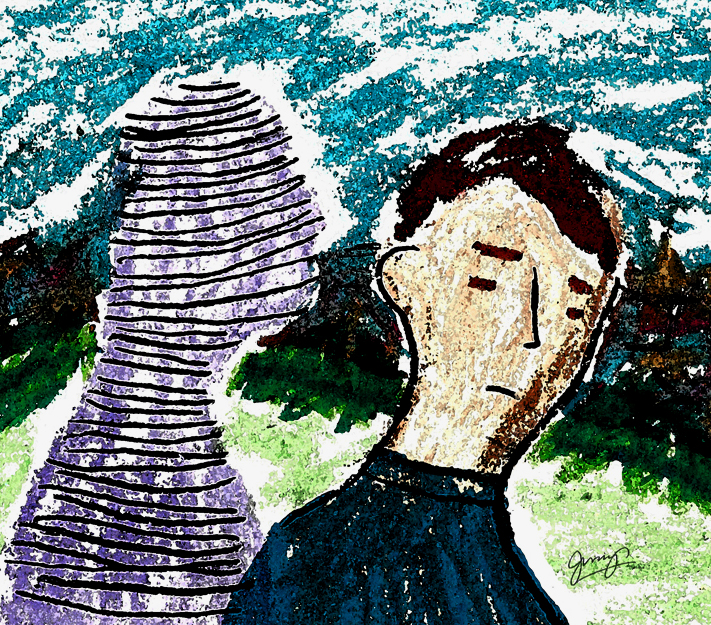
illustration by Jameson Currier
ABSOLUTION
by Jameson Currier
Bert Lennox sat in the upstairs common room of his hotel, waiting for the desk clerk to bring him a new card key for his room. Bert was locked out. His card key was inactive. He had already gone up and down the stairs three times to have it reprogrammed, each time without the success of accessing his room. He was beginning to think his trip to Scotland was a mistake; he had arrived during a rare heatwave. There had been delays with the flight, with his luggage, with his hotel reservation. His cellphone stopped working. He had decided to visit Scotland after selling off his parents’ house in Georgia. Bert’s father had died at the age of eighty-six, two years after Bert’s mother’s death. Bert was fifty-eight, the only son of three children; his sisters were married with families of their own. Bert had left Georgia at the age of twenty-one, shortly after college, to move to Manhattan. His explanation was that he wanted to find a career, when the truth was, he was searching for himself. He thought himself different. He was secretively gay and wanted to remain unconfrontational with his family. He had tried to be a good, long-distance son and brother. But he knew he wasn’t. Just by leaving, he had been cast as the black sheep of the family.
Years later, in his parents’ house, Bert discovered notes in a composition book his father had made when his parents had visited Scotland two decades before. His father had been a passionate researcher of their line of the Lennox family history, but something had changed on that trip. His father no longer wanted to talk about the family history or the Scottish ancestors. After the funeral, the estate auction, the house repairs, and the closing, Bert wasn’t ready to return to Manhattan to resume the dysfunctional career of a legal researcher he had cobbled together for himself. Scotland seemed to be the last, mysterious, tenuous string remaining to his family.
The common room of Bert’s hotel in Edinburgh was decorated with heavy leather chairs, dark bookcases filled with volumes of books that were never taken down from their shelves and read, a sidebar with a trolly of liquors sitting atop a mirror tabletop. It was late evening; heat was trapped in the space. The only light came from a dimmed pole lamp. On the wall was a painted portrait of a Scotsman from a long-gone era. The man was in a long-sleeved white shirt with a stiff, high collar and wearing a velvet cap. It wasn’t a flattering portrait. The eyes were narrow and suspicious; the nose and face were long and thin and gave the Scotsman an ominous attitude. The moustache and goatee were thin and whispery. It wasn’t a portrait of a man who could be trusted. As Bert stared at the details he saw the portrait change. A short man in a white shirt and a tartan kilt materialized in front of him. He bore a small resemblance to the portrait but had lost the cap. His hair was thinner than the goatee and curiously stirred, as if by a breeze of the hot, stuffy air.
“I’d recommend the whiskey,” the man said. “Not our finest, but it might take off the edge.”
“I prefer bourbon,” Bert answered. He tried to believe the man was a man but he knew he wasn’t. There was something too whispery about him, so Bert decided the man was a ghost.
“I’m afraid my taste buds predate that treasure.”
There was a movement of tiny black lines circling the man. Fleas. Or flies. A ghost with fleas. Or flies. Circling.
“I’ve been summoned to welcome you to the lowlands,” the man said.
“Should I be scared?”
“Not at all.”
“And you are?”
“Robert Mackendrick. Or what remains of him.”
“And what happened to the rest of him?”
The ghost stared at Bert; his eyes became embers of deceit. He slowly approached and placed his bony hand on Bert’s shoulder, which Bert failed to detect because there was no substance to a ghost, and said in a sorrowful voice. “You haven’t known the tragedy of your decisions. Your visit may save me from endless purgatory.”
Bert was immediately suspicious that the ghost wasn’t a ghost but a homeless man asking for a handout. “I’ve nothing of value,” he said. “And my cellphone is dead.”
The word “dead” hung in the air, or the air that wasn’t circled by the buzzing flies. Bert wondered, if the man was a ghost did he know what a cellphone was?
“I once refused to consider the consequences of my actions,” the man, or ghost, said. “My wife and daughter were lost to the Black Death. I made many mistakes. I cast blame on others and now I seek deliverance.”
The swirling flies had thickened and intensified. The ghost waived his hands and disappeared into the darkness, thankfully taking with him the abundance of flies. Or fleas.
The desk clerk arrived and Bert followed him to the door of his room. The new key worked. He thanked the desk clerk with a tip. Before he closed the door, he took a glass of the whiskey from the common room to help him sleep.
* * *
The next morning Bert had forgotten about the ghost. Or the beggar. Or the ghost of the beggar. He set out for the tourist traps along the Royal Mile. He made fast visits to the palace, the castle, the cathedral, and an exhibit about whiskey. After a tour of the underground vaults, he was sweating when he climbed the stairs to the bright sunlit street of shops. He became panicked and lightheaded as he looked for a place to buy bottled water. He spotted a souvenir shop and waited at the register as the salesclerk finished a conversation. For the last decade, his health was suspicious. He’d had an appendectomy, a torn ligament in his foot, a couple of root canals, and been diagnosed with heart issues. Outside the shop, he drank from the bottle. The water was warm but it helped.
He walked a few feet, found a shady spot in a narrow alley between two buildings, and tried to regain his strength. He could feel sweat drip from his scalp into the collar of his shirt. He worried about catching a cold. Yes, a cold. The heat and the dampness and the chill of the wet shirt against his neck. He had once caught bronchitis from just such a combination. A fly buzzed around his head. He swatted and heard it at his ear: “He’s no good, that one.”
He swatted at the fly again and leaned against the stones of a building. He saw the eyes first, yellow circles in the shade. A woman, dirty and dressed in rags materialized in front of him. “He thinks he can play nice, charm one man and gain absolution,” she said. “Give you a glass of watered-down whiskey, that one. He’s a devil and you’re a sap.”
“Who?” Bert asked.
“Robert Mackendrick. The devil himself. He killed more than he loved.”
“In battle?”
“With accusations, you fool. And the consequences went down generations. Just look at you.”
“Me?”
“Are you daft? He cursed our kin. Called us witches.”
“What?”
“That boy was cursed before he was born. The devil’s blood runs through your veins, even if it is as thin as that whiskey of his. Some secrets are best kept secret, you know, but there is no reason to become sentimental.”
“What?”
“The justice is that Robert Mackendrick has been rotting for centuries. No one needs to save him from purgatory, least of all you. He’s got a cause and you better be aware.”
The woman vanished, just as the ghost the night before had. Bert looked out into the busy street to see if anyone had detected the ghost or his irrational movements while speaking with the ghost. He realized he was invisible, just another tourist walking and shopping and touring, as unseen as the ghost. He carried his depression into the sunlight and walked back to his hotel to take a nap.
* * *
Bert woke from his nap sweating. The air conditioner in the room had stopped working. He fidgeted with the remote control, then pushed the buttons on the wall thermostat trying to reset it. Still no cool air circulating. He didn’t want to complain. But he also didn’t want to suffer.
He grabbed his knapsack and went down to the front desk to report the condition of the air conditioner. The clerk at the desk made a remark about the unusual heat. Bert went outside to find a restaurant. As he was walking toward the old town, he noticed a pub with a gay rainbow pride flag flying above the entrance. It took him back to a memory when he was in college and nothing was marked. The first gay bar he ever went to had no sign that it was a gay place. The entrance was a door in the back of the building.
By the inside of the door of the pub was a flyer of a map with a pink triangle along with other flyers for tourist attractions and exhibits. Bert learned that he was in the gay neighborhood of Edinburgh. In New York, he’d been fortunate to find an apartment in the West Village but never fortunate enough to afford it and had to move uptown to Chelsea, where, it seemed, more unfortunate poor gay men lived. Even in mecca it was hard to meet someone. He had friends and tricks and lovers, but never a partner. A long-term someone. Bert sat at a small table in the corner of the main room of the pub. His waiter was a young man with short black hair and tattoos on his forearms. The meal was good, but Bert felt vulnerable and invisible. Too old for hookups and no interest in hiring hustlers.
Bert dug through his knapsack to find his Dad’s composition book. He looked through his father’s notes, the names and dates of ancestors in Scotland: Nathaniel Lennox. Jonah Lennox. Sara Lennox. Ian Lennox. Jonah and Ian had emigrated to America in 1708. Jonah was twenty-nine. He found work in a paper mill in Philadelphia. Ian was seven. He started to work in the mill when he was fourteen. In the margin of the notebook page his father had written: “Brothers? Father and son?” Beside this was another name “Robert Mackendrick.”
Why was Mackendrick here? In Scotland. The ghost of the man who had welcomed him the night before at the hotel. Who was this? Was Mackendrick a Lennox family ancestor? Had Robert Mackendrick stopped his father’s research?
Bert sat at the table too long, nursing a glass of wine, thinking if he were to be visited by ghosts, why couldn’t the ghost of his friend Dave haunt him? Dave had been dead more than twenty-five years, but Bert still talked to him, still pummeled him with questions that never elicited a ghost or an answer. Dave had always made him laugh. He was nostalgic for his lost sense of humor. He felt a sigh of defeat. He had wanted to tell his parents he was gay and was in love with another guy. Instead, he told them that he was gay and his friend had died and another was sick. The black sheep had arrived with disappointment, grief, and depression. A year later, when he had returned for another visit, his mother drew him aside and said that they had not shared his news with anyone outside the family. They’d kept it private. A secret. A family secret.
After dinner Bert walked to the tartan store he had seen near the castle to see if there were any designs for the Lennox clan. There were mugs and flags and magnets. Nothing he wanted to buy. On the walk downhill, he stopped for water, drank it in the same alley as before, wondering if he might encounter more flies and witches. No one appeared. So he walked back to the hotel. Luckily his card key worked.
* * *
After breakfast, Bert walked to the National Records. The archives were daunting. It was a long, slow process, but a clerk finally helped Bert verify his father’s notes, the death dates of Nathaniel Lennox and his wife Emma. Another book revealed the death of Robert Mackendrick: male, 33, farrier, October 8, 1694, Edinburgh, by hanging, on charges of murder.
Murder? And now he was being haunted by the ghost of a murderer? He laughed because he didn’t know to react any other way.
It was mid-afternoon when Bert was back out on the street, but the heat was bearable and a crisp breeze lifted his depression. He wanted to return to the hotel to nap, but decided to find a place to sit and catch his strength. He doubted he would ever get another chance to visit Scotland. He sat and sipped at a bottle of water and realized from looking at a map, that he was near the National Gallery.
Bert wandered through the rooms of the National Gallery, studying landscapes and portraits and exhibition details for any clues that might reveal themselves. He was walking through an exhibit on witchcraft when the portrait of a solemn man wearing a black robe and a wig of curls caught his attention. At first there was something about the eyes, then the details of robe. It appeared as if there was a fringe at the folds of the robe and when Bert took a closer look he was startled to see it was a stream of flies. He stepped back when he thought he saw one move its wings.
It was an hallucination, but Bert eyes darted around for certainty. He walked away from the portrait. He was in another gallery when he heard the fly at his ear. “The devil hides in gentle faces,” a voice said. “Such wickedness shall not be left unpunished.”
Unlike before, no ghost materialized. Bert walked back through the gallery and found the portrait of the man. It was labeled Francis McDuff. Beside the portrait was a summary of the painting. Francis McDuff was a judge of many witches’ trials during the period 1680-95 against the individuals accused of witchcraft and related crimes in Scotland. Bert sat on a nearby bench and checked his father’s notes and the facts he had verified at the National Records. There was no mention of Francis McDuff in the notes. But Robert Mackendrick had been executed in 1694. Nathaniel Lennox had died in 1694. Bert looked at the other family members and saw that Nathaniel’s wife, Emma, had died in 1694. Had Robert Mackendrick been a witch? Had Bert’s ancestors been witches? Or had an ancestor accused someone of witchcraft? Could that have been the cause that shut down his father’s research?
He had dinner again at the gay pub. The young waiter with black hair and tattoos showed no sign of having served him the night before. Bert sat at his table reading his father’s notebook. Back in his hotel room, the air conditioner was on and had turned the room icy cold.
* * *
Bert Lennox was short and slender; his high forehead and weak profile gave him a bookish appearance, which he seldom tried to contradict. He tried to achieve, to standout, be distinct, but he was always overlooked. He had never been one of the cool kids or big shots, never part of the team or the crew or the gang. He was a loner. His father was not a mentor; his mother was not his champion. They were supportive, but they expressed their love for their son quietly and dependably. They wanted him to fit in. They wanted him to be happy. They worried about his health. The remarkable thing about Bert’s life was that he had not contracted HIV.
Bert did not falter his childhood or education. There were no fights between his parents, no claims of adultery, no threats of divorce. While there was little emotional support or communication from his parents, he wasn’t disowned when he announced he was gay.
Still, Bert thought he carried too much baggage: missed opportunities, wrong choices, an empty wallet, and a lack of skills both marketable and husbandry. He had trouble with opinions; they found him like insults. He knew he lacked self-confidence. But he hoped that it was his way to remain humble and grateful for things that came his way.
Twenty years before, his parents had gone to Scotland for a few days and ended up staying for three weeks. Bert’s mother had told him that she visited the souvenir shops while his father was researching in the library. His mother came back with blankets and capes and napkins and mugs. His father’s notebook was full of names and places and facts. There was no record of their events in Scotland, no description of meals at restaurants or visits to museums or tours they had taken. No sentiments, no opinions recorded. It was as if his father was searching for something he didn’t know he would find.
* * *
Bert was on the steps of the National Library before it opened. He had found in his father’s notes a list of sources he had read regarding Nathaniel Lennox. It was the third book Bert found that contained more clues. Nathaniel Lennox had accused Robert Mackendrick of the rape of his daughter Sara. Mackendrick accused Nathaniel and his wife Emma of witchcraft. No advocate would step forward for Nathaniel Lennox and his wife. Mackendrick defended his honor by killing Nathaniel Lennox. Emma was swiftly found guilty of witchcraft. The judge who ordered the executions in 1694 was Francis McDuff. Robert Mackendrick was found guilty of the murder of Nathaniel Lennox. He was hanged in 1694. The same judge, Francis McDuff, had ordered the execution. Bert checked his father’s notes again. Sara Lennox died in 1695 in Glasgow, the same year and place where Ian had been born. There was no recording in the notebook if Sara was Ian’s mother. On his father’s chart of ancestors, Jonah had been indicated as Ian’s father, perhaps because they had arrived in America together. But his father had also written in the margin here, beside Jonah’s name. “Unmarried?”
Unmarried? Jonah Lennox was unmarried? Was that the secret that had stopped his father? An unmarried man? Or the discovery of an illegitimate child at the tip of the ancestral chain?
On the walk back to the hotel, Bert took a different route. Instead of descending the road and the hill, he walked atop it. There was a cemetery entrance. He walked slowly and reverently through the grounds, reading the gravestones and memorials. The hills overlooked the streets below. There was a splendid view of Edinburgh. Bert was thinking how his father’s grave was in a field of American veterans’ markers when the ghost of Robert Mackendrick found him.
“Are you here?” Bert asked the ghost, meaning, was the body of the man buried in this cemetery.
“No,” he answered.
“I lost my wife and son to the Black Death,” he said. “Sara Lennox was a midwife, like her mother. I didn’t rape her. I loved her. She was a new life for me. A second chance. When she became pregnant, her father accused me of rape. I countered with the charges of witchcraft. The fight with Nathaniel was out of defense. Everything moved swiftly after that. I would have married Sara. I never got to see my son Ian.”
“If what you say is true, then I am all parts evil,” Bert said. “Part witch, part murderer. Throw in the notion that I am ‘unmarried’ because of my sexuality and I am the unworthy soul now on trial.”
“Will you forgive me?”
“I don’t know the facts. I only know the sides I have been given. Incomplete and none first hand. Yours and others. I’m not the one to decide on any of this.”
“What can I do to persuade you?”
“I don’t understand any of this,” Bert said, then clarified, “By this, I mean religion. Heaven and hell and purgatory. It’s like believing in witches and ghosts, right? How can I be asked to absolve someone when I don’t believe in the fundamental chaos of religion. If it were science proving that an atom can be split, I’d agree, but you are asking me if I prefer your opinion to someone else’s opinion, and what I have discovered is that I’m compromised on all sides. The boy was my ancestor. Possibly your son. Sara’s son. I am not the one to judge any of this.”
“Your father made the same decision,” the ghost said. “Which is why I sought you out.”
“I’m not my father,” Bert said. “I’m different.”
A circle of lines began to swirl around the ghost of Robert Mackendrick. Flies. Or fleas. In large quantity. As Mackendrick began to fade, Bert heard a fly at his ear. “Nothing wrong with being different, luv. Different is good.”
Bert sat in the cemetery until the light began to fade. He walked down the hillside toward his hotel and stopped at the gay pub for dinner. His waiter was again the same guy with the tattoos who had served him the two prior times he had eaten at the pub. “Back again? You must like this place,” the waiter said.
“Yes,” Bert answered. “It’s starting to feel like home.”
___________
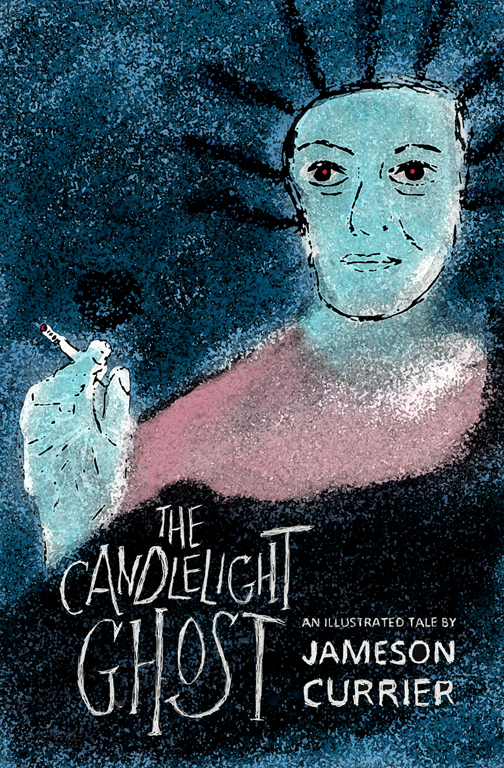
Jameson Currier is the author of several ghost stories with gay characters and themes, among them the novel, The Wolf at the Door, the story collection The Haunted Heart and Other Tales, and the illustrated story, The Candlelight Ghost.