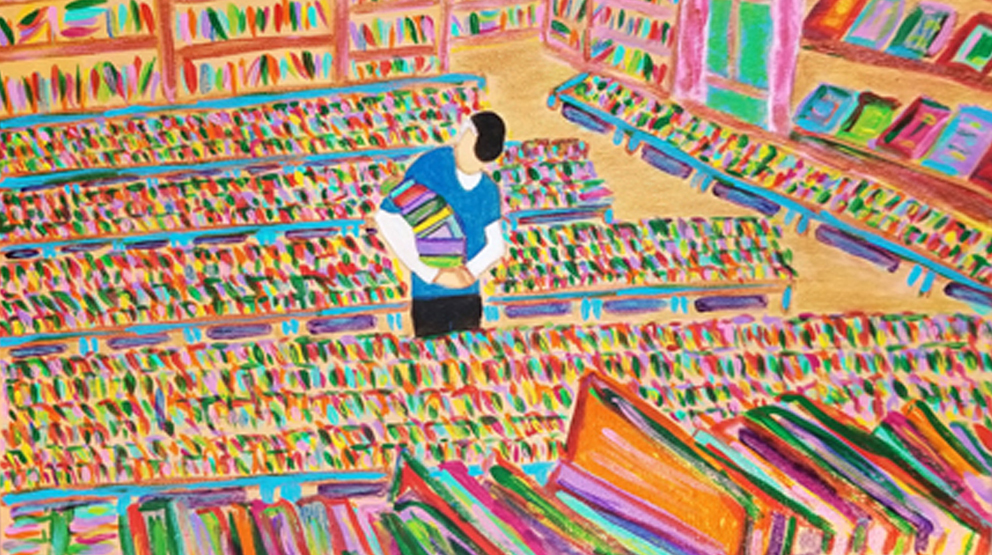
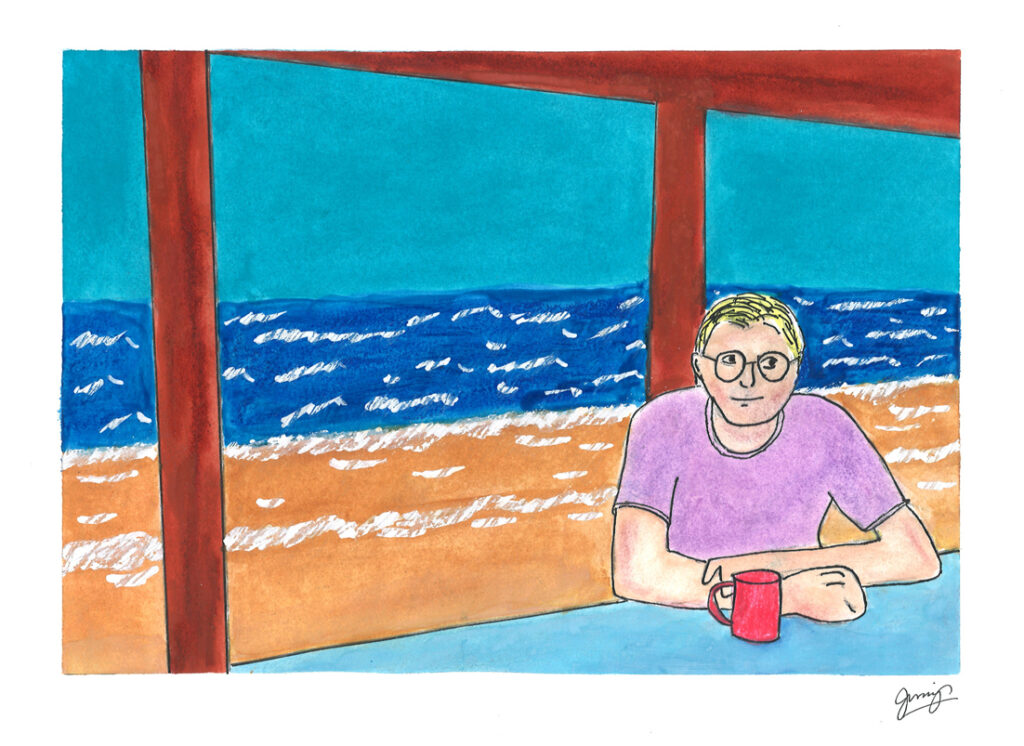
David Hockney in Malibu
art by Jameson Currier
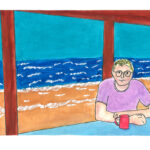
Watercolor, pen and white out on paper. 2018
There was a time in the late 1980s after my friend Kevin had died that I was searching for my next career path. I no longer wanted to be a publicist and I took a series of temp jobs, including a two-week stint in the Publications Office of the Metropolitan Museum of Art. The office was not in the Fifth Avenue building but in a townhouse on one of the nearby side streets. I have long forgotten what my task there was (unlike the temp job where for days I typed (with carbon paper) lists of the VIN numbers of automobiles in an abandoned lot in Queens). But one of the perks of the Met job was an ID badge that got me into the museum where I would eat lunch at the employee cafeteria located off the lobby (now consumed by the retail shop). I seem to remember that the employee cafeteria was also subsidized: another perk. After lunch, I would wander into the retrospective exhibit of David Hockney’s paintings and marvel at them (and confused why the Met was exhibiting a contemporary living artist—I was never savvy about art and museums and the marketplace). I loved that exhibit because I saw it over and over. Another perk for which I am grateful.
Decades later, one of the perks of the dysfunctional corporate job I maintained was free admission to the Met and in 2017, with my friend Jon Marans, I went back to the Met to again specifically see a Hockney exhibit.
Along with Duncan Grant, I think Hockney is my favorite artist. One thing that I admire about his work is that it is instantly recognizable as created by him, in part due to his distinct visual “line” or stroke of the pen or brush, something every artist has. I remember an evening workshop in Chelsea in 2016 I went to when I decided I wanted to learn more about drawing and I was asked to sketch three objects. I sketched a wine bottle, a wine glass, and a diary. The instructor gushed over his regular students, but since I was a walk-in I was pretty much overlooked and told I could have my sketch if I came back for another class. (I took a picture and did not come back.) I did not receive a critique, though there was a moment where a middle-aged woman with a falling bun of brown-gray hair and the tiny, wiry bald male instructor stood at my side looking at my drawing and were conversing heatedly in French and pointing to the way I sketched the pages in the diary and the curve of the glass which I had made more into a goblet. I caught the name “Matisse” in the flurry of words, though I don’t know in what context. Now looking back at the photo of that sketch, I see that my “line” was visually distinctive and identifiable even when I didn’t know what I was doing. (And most days, still don’t.). But back to Hockney: I love that his “line” is so identifiable to me.
I’ve always admired Hockney’s color palette and the preciseness to his art and for many years was baffled how he achieved it until one day a few years ago when I was studying one of his paintings up close at the Whitney, I began to see him painting out of the lines and there were drips and splatters in the wrong places. I was amazed and delighted and relieved and thrilled to see him as human.
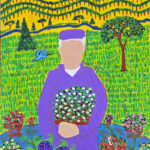
There was a time a few years ago when I was working on some watercolor portraits of artists in their locales. I drew Duncan Grant at the Charleston house, Keith Haring in New York, and David Hockney in his Malibu house from a composite of pictures I found online (and then I was pulled away into another project).
If Fate allowed us to choose our mentors, I feel strongly I would have chosen David Hockney.
RIP.