art by Jameson Currier
THE BLUE SEED
By Jameson Currier
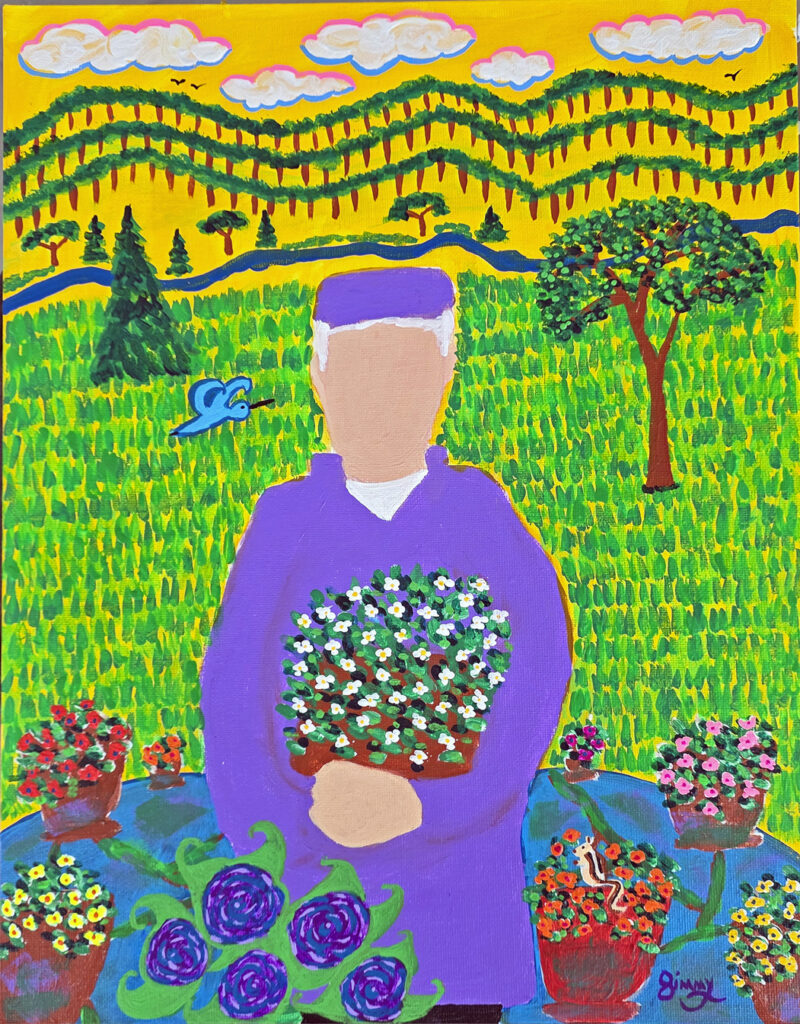
After thirty years working as a paralegal for a large corporate firm—professionally invisible but privately indispensable—Jimmy retired to a farmless farmhouse in the country with less than a quarter acre of land. He was an aging gay man with a weakened heart, exquisite taste, too much body fat, and absolutely no retirement money. What he had instead was time, creativity greater than talent, a stubborn sense of fairness, and a large, blue-slate patio where he could plant a flower garden.
The first month of his retirement, Jimmy bought several discounted clay pots at the local garden store, filled them up with dirt, and arranged them around his blue-slate patio. He bought seeds and bulbs and cuttings and starters and planted them into his new pots and gave them water and hope. And every morning, Jimmy discovered something had sabotaged his efforts. Holes were dug into the dirt. Seeds were eaten. Flower stalks were tossed onto the patio. There were tiny paw prints of dirt atop his beautiful, blue-slate patio. One day, out of the corner of his eye, Jimmy spotted a chipmunk cleaning his paws as if he were mocking him.
Jimmy was not discouraged. He had set up impenetrable shell companies for lawyers hiding money for their clients, or sometimes for themselves. He planted thin, wooden stakes and sticks into the clay pots and arranged plastic forks as spikes around his flowers to deter the chipmunk from digging and destroying. Next, he added stones too heavy for the chipmunk to upend. This worked for a few weeks, enough for the flowers to grow and bloom, until one day he noticed a red ceramic flower pot among his clay ones. Jimmy did not remember ever buying a red ceramic flower pot.
When Jimmy bent to inspect it, the chipmunk sprang out of the dirt, eyes gleaming with hate.
“Nope,” the chipmunk declared. “This one is mine.”
The chipmunk raised his front paws and rubbed them together and hissed, or laughed. And suddenly, Jimmy shrank to the size of a tomato.
Panicking, Jimmy staggered around the patio and fell into a clump of dirt. Plenty of lawyers had demoted and demeaned him, but there had never been cause for him to be cursed and shrunk to a size smaller than a Barbie doll. Jimmy was only preventing the chipmunk from damaging his personal property and the promise of the future—a blue-slate patio of beautiful flowers. He yelled at the chipmunk in the red pot: “This is not fair. I never poisoned you. I never set out traps to kill you!”
A hummingbird appeared, hovering calmly as if this sort of thing happened all the time.
“There’s a blue seed in the red pot,” the hummingbird whispered in Jimmy’s tiny ear. “If you find it and eat it, it will grant you three wishes.
“Why doesn’t the chipmunk eat the blue seed himself?”
“It would kill him to eat it,” the hummingbird said. “It contains too much power. The laws of the universe do not allow this sort of behavior.”
Jimmy was aware that he was not aware of all of the laws of the universe, along with who or what had the ability to fabricate a curse. There were so many laws and he had spent years trying to sort them out: the laws of humans, the laws of the country, the laws of the state and the county and the small village where the farmless farmhouse was located. And now, here, he was up against the laws of the universe.
Jimmy had to wait for the chipmunk, now the size of a dinosaur, to leave the red pot before he could discover the blue seed. When it looked like the chipmunk would never leave his new fortress, Jimmy dragged acorns and seeds to tempt the chipmunk out of his domain.
The scheme worked, and while the chipmunk devoured his free food, Jimmy climbed into the red pot and found the blue seed. He popped it into his mouth and chewed. It had a bitter taste, like all blue pills.
“You may now wish,” the hummingbird said to Jimmy when he had climbed out of the red pot. “But you must not ask all three wishes at once or they will all backfire, as this is one of the unspoken laws of the universe.”
The hummingbird confused Jimmy with the notion that there were unspoken AND spoken laws when there should only be written and unwritten laws.
“And listen carefully,” the hummingbird continued, “Full disclosure, each wish may be legally binding in ways you will not enjoy.”
Jimmy, who had spent decades spotting loopholes for other people, carefully made his first wish: “I wish to be my full self again,” he said.
Instantly, he returned to his normal size. Unfortunately, he felt too large and too visible to feel comfortable. He was easily overwhelmed by ordinary things—the wind felt aggressive, noises felt personal, and he cried for twenty minutes when he stumbled upon a rerun episode of Bewitched on his laptop, where ALL laws were topsy-turvy.
Still, he adjusted and adapted. He always did.
He returned to his patio, watered his flowers; the chipmunk screamed at him, nipped at his fingers, and spent more time digging in the clay pots. Finally, Jimmy made a second wish, “I wish for peace in my garden.”
Over the next few days, the garden exploded into abundance. Flowers bloomed wildly. The chipmunk stayed in his red pot. Until one day, a violet rose appeared—soft and gorgeous. And then there were more.
The problem was that everyone noticed the violet roses. Neighbors wandered on to Jimmy’s blue-slate patio to see the roses. Strangers stopped their cars in his driveway and took photos of the violet roses and posted the pictures on social media so that more strangers arrived and took photos. Influencers appeared, trying to capture the roses at sunrise and sunset, in heat and rain. Jimmy, who had spent a lifetime behind the scenes and being ignored, now couldn’t drink coffee without someone asking if the violet roses were “symbolic” of something.
Peace, it turned out, was not the same as popularity. And there was no way for Jimmy to monetize his new fame. He went about as he always did, gardening and spending more money than he budgeted.
And then one day, a clerk from the local village appeared at Jimmy’s front door and smiling the way people do when they think flattery is a strategy. The clerk said, “This is the most popular farmless farmhouse in the county. Because of its new beauty and popularity, we have reassessed your property value. Here is your new tax bill.”
In a moment of weakness—or an aftershock of learning that the unspoken laws of the universe had caused his property taxes to increase, along with the unenforced laws of humans rising the prices of gas, beef, milk, and eggs while his pension income remained the same—Jimmy said, with a hint of frustration, “I wish billionaires would be taxed!”
And next he laughed. A deep, tired, surprised laugh.
“Of course they will be taxed,” the clerk said. “Some day. Some where.”
After the clerk left, Jimmy noticed the hummingbird hovering beside him.
“You didn’t get everything you wished for,” it said.
“No,” Jimmy replied. “My wishes were not used wisely and were not without consequences.”
After a while, the novelty of the violet roses evaporated, Jimmy tended to his garden of clay pots on his beautiful, blue-slate patio—still poor, still aging, still himself—living a life that felt deliberately and imperfectly his. The chipmunk watched from his red pot, plotting, but never quite winning. Occasionally Jimmy would see the hummingbird humming about his yard and wonder about wishes and fairness and the laws of the universe and elsewhere. The hummingbird never said anything about another blue seed. But Jimmy never gave up hope of finding one. Even if it were bitter too.