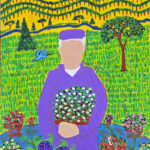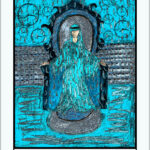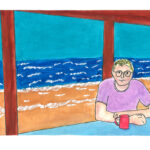
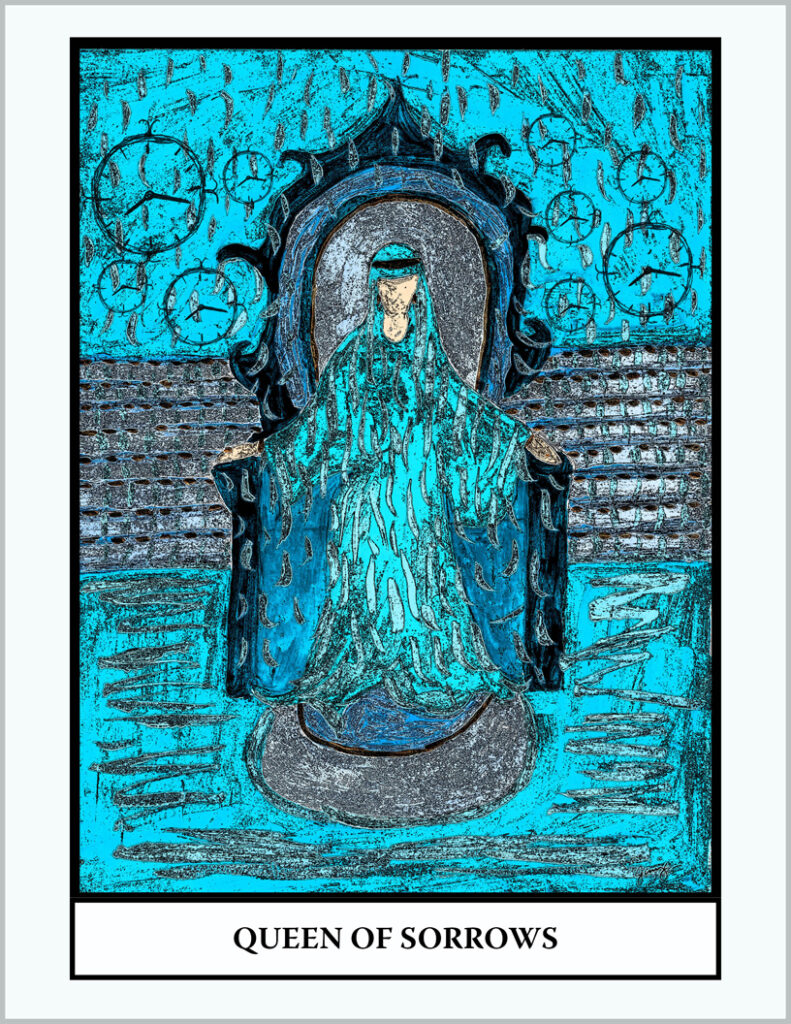
illustration by Jameson Currier
THE QUEEN OF SORROWS
by Jameson Currier
On the evening the King died, the clocks stopped out of courtesy.
No one had instructed them to do so. The palace electricians would later swear this under oath. But at 8:17 p.m.—the precise moment the King inhaled a sugared violet at the Annual Gala for the Preservation of Smaller Galas and failed to exhale—the clocks in the palace shuddered and refused to continue.
The Queen took this as confirmation.
“Time,” she said, pressing her fingers to the King’s cooling wrist, “understands hierarchy.”
The King and Queen had been married for too many years. It was no secret that the Queen did not love the King when he died, but since she was between lovers, she took his death personally, because it would force many changes. This made the Queen more bitter than sad, and that evening, after the clocks had stopped, as she made her way to her chambers, she thought of all the things in all of his lifetime that the King had not done to make her happy. Or happier.
Condolences did not arrive swift enough from the members of the Royal Court or even the Royal Guards and the Queen’s chambermaids to distract or appease the Queen. Instead, as she brooded, she recalled favors that had been granted to others, on her behalf by the King, and vowed to collect on each as if it were a debt. The Queen wanted accountability, which in her language translated into revenge.
By dawn the Queen had issued three decrees.
First: all mirrors were to be draped in black lace so that no one would accidentally glimpse a future in which the Queen was not grieving.
Second: laughter required a permit, obtainable through a seventeen-page application and a modest processing fee.
Third—and most important—Grief now belonged to the Crown.
This was not metaphorical. The Queen could see it. Grief was visible.
In the dark hours of the night, the Queen had summoned the Chief Legal Counsel and Executive Wizarding Officer and had drafted a Royal Decree and cast an Unbreakable Spell of Exclusive Bereavement that made Grief proprietary to the Crown, which meant, to her.
Grief now appeared as a silver vapor escaping from mouths, cuffs, buttonholes. It rose from chimneys and bus stops and supermarket aisles. It gathered above the kingdom like a low, luminous fog. The Queen alone was capable of perceiving its shimmer, and so she alone was qualified to steward it.
She had the Supreme Royal Alchemist obtain special jars made of faint blue-tinted glass. The jars were labeled PROPERTY OF THE CROWN in a tidy, cursive script. The Royal Guard went door to door with velvet sacks and gentle instructions.
“For Her Majesty’s preservation,” they explained.
The people surrendered their vapor. Most of them did so gratefully. It was a relief, in a way, to have someone important declare your ache part of a larger project. But there was another, hidden purpose to this mission. The Queen needed to be sure that no grief outranked her own. Since Time had stopped, the Queen remembered more about the King—how he had loved her, how she had worried about his day, the way he would nod his head when he held an audience with his subjects, as if he was actually listening to them. Her denial of the King’s death had morphed into anger and hysterics. The King had left behind too many unresolved issues. Why hadn’t he planned to take care of her in a crisis like this? Why did she have to make all the decisions? The Queen summoned the Chief Legal Counsel and Executive Wizarding Officer to create a list of things she should never forget. After reviewing each item, she would sigh and ask, “Why? Why did this happen? Why did this happen to me?”
As the Royal Guards of the Queen collected the Grief of her kingdom, the castle grew colder. Snow fell exclusively within palace grounds. It did not accumulate elsewhere, as if the weather had signed a confidentiality agreement. And, as if not to be undone, the Queen proclaimed herself the Queen of Sorrows.
* * *
Adrian was a tailor. He specialized in mending garments no one wanted to wear anymore: prom dresses, christening gowns, robes for graduations and investitures. He was the sort of man who remembered everyone’s birthday and owned three kinds of black thread. His shop smelled faintly of wool and coffee and something citrus he could never quite identify. His best friend, Tomas, had died the same evening as the King, and without ceremony.
No sugared violets. No chandeliers. No televised retrospectives. Just a hospital corridor, a vending machine that refused to accept coins, and Tomas squeezing Adrian’s hand once, twice, and then not again.
Tomas and Adrian had been friends since they were boys. There was a time when they were more than friends and which was the reason why they remained best friends and roommates and not interested in maintaining relationships with others. Tomas left behind a houseplant that required indirect light and several unfinished crossword puzzles, each stalled on a word Adrian suspected he would have known.
Adrian’s grief did not look like silver vapor. It behaved more like rain. It fell upward in a fine mist whenever he spoke Tomas’s name. It collected along the ceiling of his shop and beaded there like condensation.
When the Royal Guard arrived with their blue jars and velvet sacks, Adrian was hemming a mourning veil for a duchess who preferred her sorrow breathable.
“We’re here to collect,” the taller guard said kindly.
Adrian glanced up. “Collect what?”
The shorter guard cleared his throat. “Emotional emissions.”
Adrian considered this. A drop of upward rain struck a light fixture and refracted.
“I’m still using mine,” he said.
They explained the decree. They pointed to the vapor clinging to his rafters.
Adrian set down his needle.
“I’m not hoarding,” he said. “I’m remembering.”
The taller guard looked almost apologetic. “That is precisely the issue.”
They arrested him for Emotional Hoarding, which carried a sentence of either a fine or an audience.
Adrian chose the audience with the Queen.
* * *
The Queen of Sorrows presided over the tailor’s Trial of Grief in a throne room converted into a personal climate zone. Ice webbed the stained-glass windows. Frost traced the gold filigree of the throne. Behind her, shelves upon shelves of blue glass jars glowed faintly, humming with captured grief.
The Queen appeared carved from candle wax and determination. “State your loss,” she commanded to Adrian.
Adrian did not kneel so much as incline. “My friend Tomas,” he said.
The word friend fluttered through the hall like an unauthorized bird.
The Queen gestured, and one of the alchemists leaned forward with a fresh blue jar.
“Proceed,” she said. “We will determine its worth.”
Adrian blinked. “Its worth?”
“All grief is measurable,” said the Queen. “Mine is incalculable. We will see where yours falls.”
He thought about arguing the premise. He thought about Tomas, who would have made a joke about competitive sadness, complete with imaginary trophies.
Instead, Adrian said, “He mispronounced foreign film titles on purpose. To see if anyone would correct him.”
A murmur traveled through the Court.
As the tailor spoke, the air beside him wavered, as if heated from below. For a moment—only a moment—the shape of two men sitting on a sofa flickered there. One of them was laughing.
The frost along the nearest pillar retreated half an inch.
The Queen narrowed her eyes.
“He posted videos on his social media platforms of bad parking attempts,” Adrian continued. “He thought this was a public service.”
A dandelion pushed up between two marble tiles and opened.
The alchemist’s jar remained stubbornly empty.
The Queen’s voice sharpened. “Describe the moment of death.”
Adrian swallowed. “He squeezed my hand. He was worried I hadn’t eaten.”
Something inside the nearest jar on the shelf flickered in response, as if jealous.
“He left three crossword puzzles unfinished,” Adrian said. “I’ve tried to complete them, but I can’t be sure which clues he would have skipped on purpose.”
Now the clocks—those stopped clocks lining the upper walls—ticked once. Experimentally.
The Queen rose.
“My husband was a King,” she said. “The people loved him but I loved him more.”
Adrian did not contradict this. He had liked the King well enough. He had once hemmed the King’s trousers and they had laughed over the shared discovery of a sugared violet that had fallen into one of the cuffs. “Do me a favor and don’t tell the Queen,” the King had said to Adrian. Adrian mentioned this recollection now to the Queen.
“Do you presume that you miss him more than I do?” she asked in a harsh tone.
“I have a memory of him. Special to me. I recall the King with fondness and I am saddened that he is no longer here to remember this moment with me.”
“I lost a future,” the Queen continued. “A thousand state dinners.”
“You did,” Adrian agreed.
“And you,” she said, almost triumphant, “lost a friend.”
“Yes.”
The word settled gently between them.
“And you dare to compare—”
“I don’t,” Adrian said.
The frost thickened around her throne.
“I don’t want more grief than you,” the tailor said. “I don’t want less. I just want mine.”
Silence.
Behind the Queen, the blue jars hummed discordantly. Some glowed brightly. Others had gone dull; their silver vapor condensed into something like dust.
“You believe grief is private property?” she demanded.
“I believe it’s weather,” Adrian said. “You can stand in it alone. Or you can notice other people are getting wet.”
A ripple moved through the shelves. One jar cracked down the middle with a delicate, devastating sound.
The Queen turned. She had not reviewed the collection of jars in days. Perhaps weeks. It was possible she had stopped looking closely at them. Now, up close, the blue jars were not uniform. Some pulsed. Some had thinned to a faint residue. A few were empty except for fingerprints.
“Why do they fade?” she asked, not entirely to Adrian.
“Because they’re meant to move,” he said.
The tailor reached into his coat and withdrew a folded paper: Tomas’s last crossword. Then he pulled at a paisley scarf that he wore, slightly frayed at one end, that had also belonged to his friend. In his pocked he clutched a cellphone, cracked at the corner, with a voicemail saved and re-saved. He did not present them as evidence. He held them as one might hold fragile weather.
The blizzard the Queen had summoned to underscore her point faltered. Snowflakes hesitated midair, reconsidered, and fell as ordinary water.
“Do you fear forgetting?” she asked him, and the question was small and faint, like her voice.
“Yes,” Adrian said.
The honesty of it did something structural to the room. A fissure traced itself along the ceiling and let in a shaft of unapproved sunlight.
“That is why I tell stories about him,” he added. “It keeps him alive.”
The Queen stepped toward the shelves.
She selected a blue jar at random—one labeled BAKER, THIRD DISTRICT—and held it up to the light. The vapor inside trembled.
For a moment, she pressed the jar to her chest as if it were a reliquary.
Then she opened it.
The silver vapor did not dissipate. It poured out in a smooth ribbon and hovered, uncertain, before drifting toward Adrian’s upward rain.
Where the two currents met, something altered.
The vapor thickened, feathered, and broke into a small flock of silver birds. They circled the throne room once, twice, and then arrowed toward the tall, arched windows.
The glass did not shatter. It simply remembered how to open.
More jars began to crack—not violently, but with relief. Silver lifted and braided with the upward rain. The dandelions multiplied, polite but persistent, yellow petals transforming into whispers of white.
The Queen did not consult her advisors. She opened another jar. And another.
The cold withdrew from the walls in visible increments.
When at last she faced Adrian again, her crown had slipped slightly to one side. She did not correct it.
“If I release it,” she said, “what remains mine?”
Adrian considered this carefully.
“The particularity,” he said. “What makes it special to you.”
She closed her eyes and said, “There is much to consider.”
The clocks resumed. Not all at once. Not obediently. One ticked. Then another. A third coughed and lurched forward two minutes as if embarrassed.
The Trial abruptly halted, as if the puddles of water forming on the floor were an embarrassment and impediment. The Queen returned to her chambers. Adrian was released and returned to his shop. Outside the palace grounds, snow began to fall for the first time all winter. Inside, it melted by noon.
* * *
The next morning, the Queen rescinded Exclusive Bereavement.
Laughter permits were shredded. The mirrors were undraped. The Royal Guard returned what blue jars they could, though many citizens chose to leave them open on their kitchen tables, just in case something needed air.
Adrian was offered a title. He declined the first three options—Minister of Emotional Resources, Keeper of Vapor, Baron of Condensation. He accepted Royal Tailor of Unfinished Hems.
Sometimes it still snowed in the courtyard. Sometimes it rained upward in the tailor’s shop. The Queen continued to grieve her husband. Adrian continued to miss Tomas. The kingdom discovered that sorrow did not diminish when shared; it altered, like weather moving across a map.
On certain evenings, if one stood very still beneath the palace windows, one could see silver birds roosting along the ledges. They did not belong to anyone. They belonged to the air.